
Oikophobia: Why Successful Societies Turn Against Themselves with Benedict Beckeld, Philosopher and Author of Western Self-Contempt
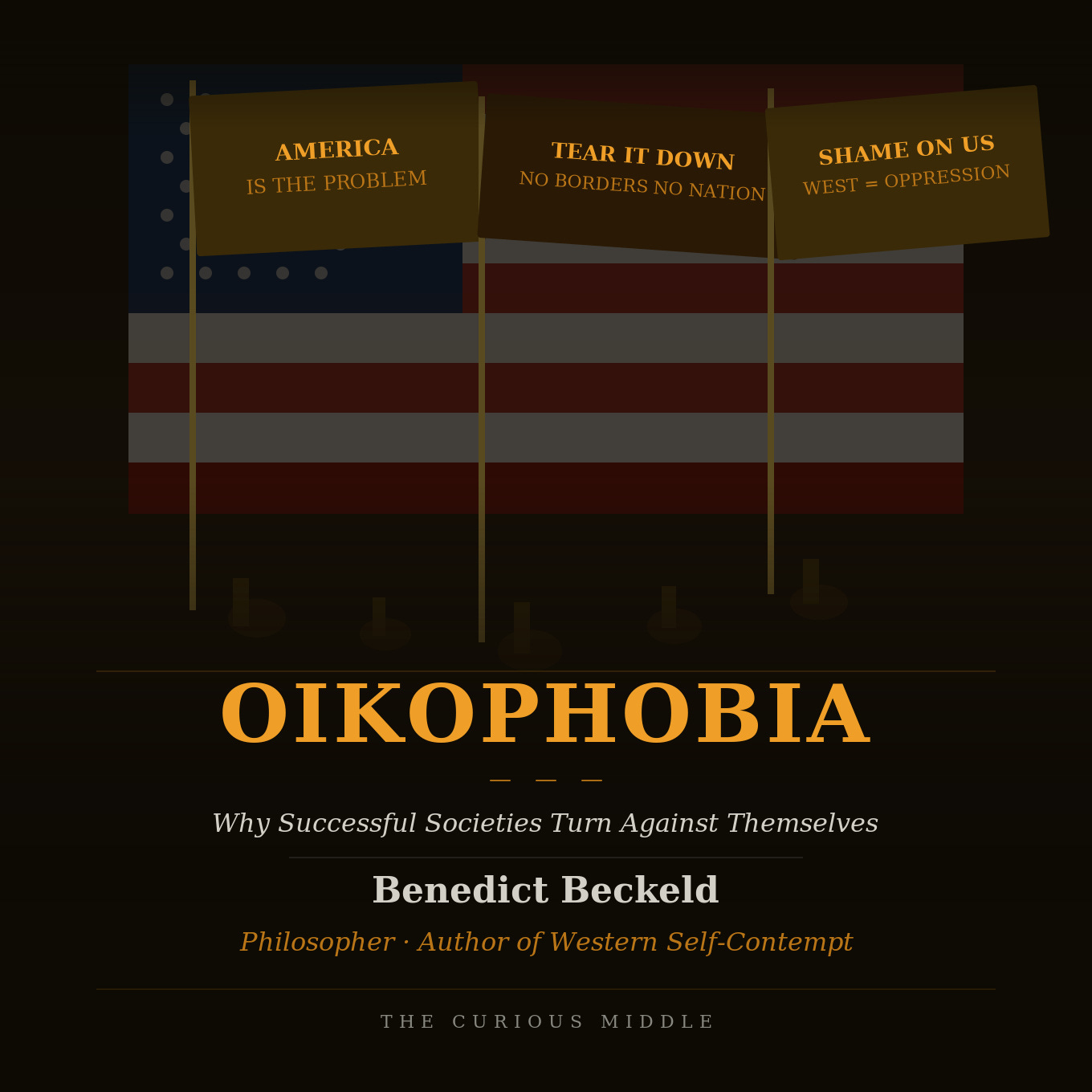
What if you could name the thing tearing America apart? Benedict Beckeld joined us to trace a pattern that has played out in every great civilization in history: ancient Greece, Rome, Enlightenment France, Britain, and now America. The more successful a society becomes, the more its own people turn against it. Wealth, safety, and open intellectual space create the exact conditions for a culture to start eating itself alive.
Benedict is a writer and philosopher whose work spans contemporary culture, political philosophy, and the philosophy of history. He holds a master’s in ancient Greek, Latin, and German, and a PhD in philosophy. His book Western Self-Contempt: Oikophobia and the Decline of Civilizations is the only full-length study of the subject, and the work that brought the term into mainstream conversation.
We get into all of it: why universities are ground zero, why intellectuals are the most susceptible, what October 7th has to do with it, whether religion is the antidote, and the uncomfortable historical truth about whether oikophobia has ever actually been reversed.
The good news, America is different. The bad news, the odds are not good. Understanding what we’re up against is the first step to fighting back.
Key Quotes
“The fact that we until recently only had a word for hating foreigners is itself a sign of oikophobia — it means it’s only the hatred of the foreign that we consider worthy of condemning.”
— Benedict Beckeld“There is nothing so human as taking a good idea too far. We take the potential positive of self-criticism and it becomes a competition about who can be the most self-hating.”
— Benedict Beckeld“Historically, it has never been reversed. Which is not to say we shouldn’t try — and I mean this, because America is unique.”
— Benedict Beckeld“Imagine if you were sick and didn’t know what was going on — you’d be panicked. But if a doctor gave you a diagnosis, you’d say: okay, I know what this is, this is how I treat it. Before this, we were very sick and had no word for it. Now we do.”
— Polina Rubin“There is a spirit of freedom in America that is unmatched in the world. You say an idea in Europe and people say, are you sure that’s wise? You say the same thing here and people say, that’s amazing, what can I do to help?”
— Benedict Beckeld
More Podcasts on Culture:
Reading and listening Suggestions:
AI
What Your History Teacher Skipped: The Bible and American Democracy
When the Israelites demanded a king, the prophet Samuel warned them exactly what they’d get: their sons taken for war, their daughters for labor, their land seized for his own. God said let them have it — but make sure they know it’s a mistake. An anti-monarchical argument baked into scripture before democracy had a name.
The Calvinist reformers read that text closely. John Calvin (1509–1564) built a theology around one uncomfortable idea: all humans are fallen, kings included. No one deserves automatic deference. Authority flows upward from the people, bound together by a covenant before God.
The Scottish Presbyterians ran with it. So did the Dutch Reformed and the English Puritans. When the Puritans came to New England, they brought both the Hebrew Bible as a governance model and Calvinist covenant theology in their luggage. The Mayflower Compact is essentially that same ancient covenant — a voluntary agreement before God, signed before anyone set foot on land.
Princeton, originally a Presbyterian college, produced more Founding Fathers than any other institution. The idea that no man is above the law, that authority requires consent, that a community is a covenant — none of it was invented in 1776.
John Adams studied Hebrew at Harvard, which required it as part of the curriculum. He wrote about the Hebrew commonwealth as a model of self-governance and called the Hebrew language one of the most ancient and consequential in human history.
Thomas Jefferson taught himself Hebrew well enough to read the Old Testament in the original. He considered it essential to understanding law and governance.
Benjamin Franklin proposed that the official seal of the United States feature Moses parting the Red Sea. Jefferson’s counter-proposal was the Israelites being led through the wilderness. Neither made it, but the fact that both men went there first says everything.
Harvard, Yale, Columbia, and Dartmouth all required Hebrew for admission or graduation in the colonial era. Yale’s original seal was in Hebrew. Dartmouth’s still is — Vox Clamantis in Deserto, “a voice crying in the wilderness,” is Latin, but the imagery is straight from Isaiah.
The Founders weren’t just casually aware of the Hebrew Bible. Many read it in the original, quoted it as a legal and political authority, and saw ancient Israel as the closest historical model for what they were trying to build.
It’s one of the most important things about American history that almost nobody learns in school
If you love history like we do, check out any podcast where Bill Federer has been a guest, like this one: why be Thankful for America with Bill Federer
We read, argue, and ask the uncomfortable questions. Join us. Add The Curious Middle to your podcast playlist. And if you have ideas for a future episode, email us at thecuriousmiddlepod@gmail.com
Follow us on Instagram at @thecuriousmiddlepod, Email us thecuriousmiddlepod@gmail.com.
Wishing you sunshine and happy moments as summer rolls in.
Love,
Polina and Yelena,
P.S. — We interrupt our serious content to remind ourselves and you to celebrate more, with people you love.